Meridale Council
Taking licensing fully digital under grant conditions that bite, with a pack that treats accessibility and the assisted-digital route as requirements rather than good intentions.
Meridale Council is a fictional company used to demonstrate Requio with a realistic, fully worked example — built end to end through the real product, not written as marketing copy. No client relationship is implied.
View the full DRP onlineThe challenge
Meridale Council is a unitary authority of 214,000 people. Its licensing service handles about 3,500 applications a year — premises and personal licences, street trading, pavement licences, skip and scaffold permits, animal activity licences, taxi drivers and vehicles — with four Licensing Officers and a senior officer.
Only 12 per cent of those applications arrive by a route anyone would call digital. The rest come by post, by email as photographs of forms, or in person. Applications are logged in a Microsoft Access database built in 2011; the documents live in a folder structure named by officer convention. Forty-three per cent of applications fail the initial validity check — a missing DBS certificate, an expired insurance document, the wrong fee for the duration applied for — and each failure stops the clock while a letter goes out and, eleven days later on average, comes back. Sixty-one per cent of the contact centre’s licensing calls are someone asking where their application has got to.
The fix is funded by a Local Digital Fund award of £480,000, and the conditions attached to it are not decorative: the money must be spent by 31 March 2027 with no extension, an independent accessibility audit must be published before launch, the non-digital route may not be degraded, and the council must be able to show measured outcomes for people who used it.
How Requio was used
Grounded in the organisation’s own documents, not general knowledge
Three documents were uploaded to the project’s AI Knowledgebase before drafting began: the council’s Digital and Customer Access Strategy with the conditions every programme must meet, the licensing service’s own current-state operating model including the figures above, and the grant award conditions in full.
The pack that came back argues from those: the 43 per cent rework rate and what causes it, the 80 per cent digital target the strategy actually commits to, the 31 March 2027 deadline with no extension, and the strategy’s own rule that assisted digital is a condition of every change rather than an afterthought.
Accessibility and assisted digital as requirements, not intentions
Two of the eight requirements exist because the source documents insisted on them. REQ-003 requires WCAG 2.2 AA conformance evidenced by an independent audit before launch, with findings published — the grant condition, written as something that can be tested. REQ-008 requires the non-digital route to be of equal standing, with outcomes measured separately and not permitted to be lower.
Each has a test behind it. One completes a premises licence application end to end using a screen reader. The other takes a street trading consent by telephone and checks it receives the same validity checks, status tracking and renewal reminders as one submitted online. A commitment that cannot be tested is a sentence in a strategy; these are requirements.
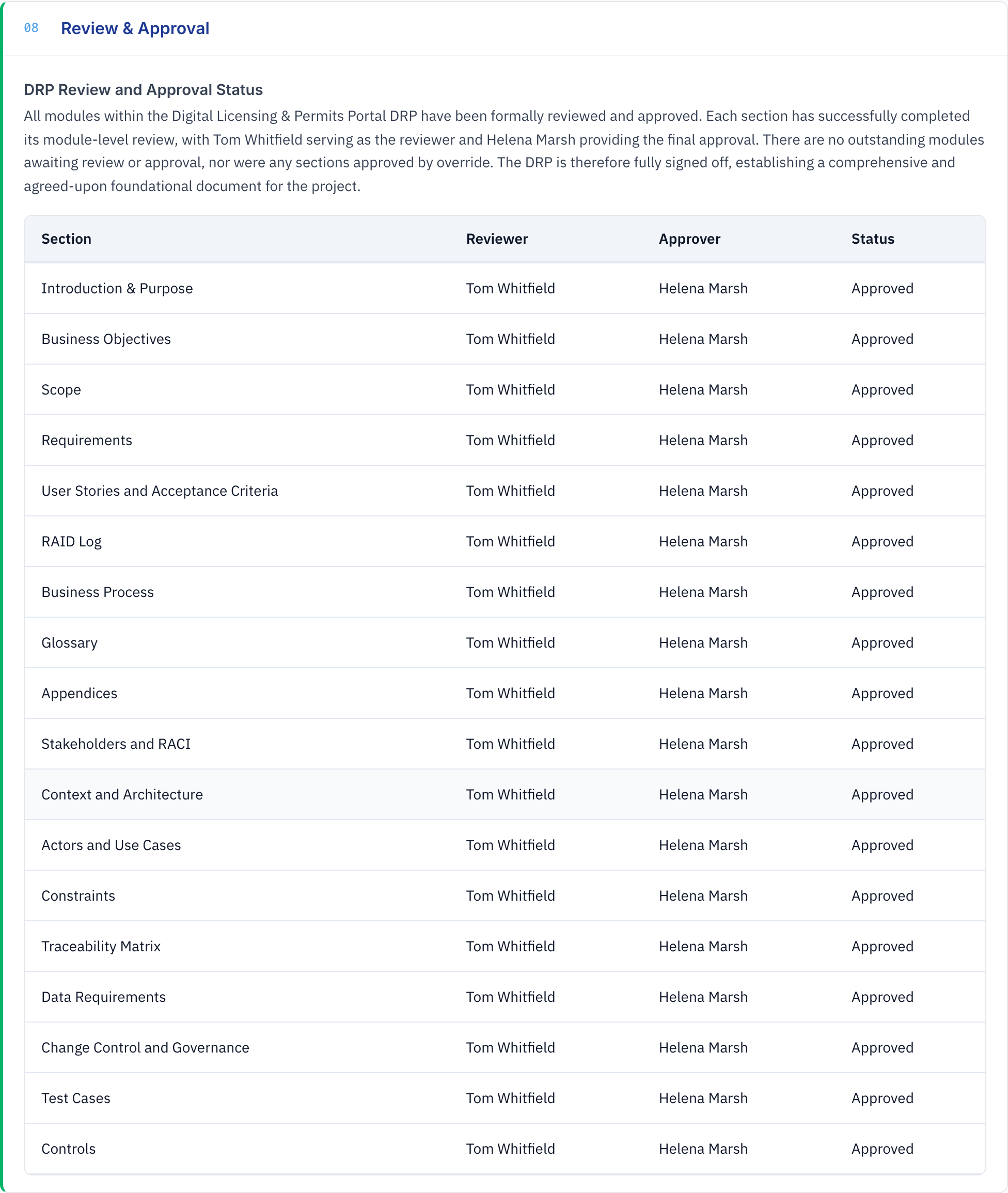
A sign-off trail with names on it
All eighteen reviewable sections were submitted by Rachel Okonjo, reviewed by Tom Whitfield and approved by Helena Marsh — three people, each doing only their own part, with the pack recording who did what and when.
Where a section changed after it had been signed off, it could not simply be edited. It had to be reopened first, which is recorded, then taken back through review before the next version could be issued. A public body that has to show its working needs exactly that: not a tidy final document, but a record of how it got there.
RAID and controls shaped by funding risk as much as delivery risk
The RAID log runs to 16 entries, and the ones that matter are not the generic delivery risks. The statutory public register is a spreadsheet republished monthly as a PDF, so it is out of date for most of its life and the council could not show it matches the determinations actually made. The assisted-digital route could quietly degrade as resources move to the portal, leaving the people it exists for worse off than before.
The controls register (12 entries) answers those directly: the published register is generated from the determination record itself, so the two cannot disagree; the accessibility audit is a control with an owner and a frequency, not a line in a plan.
Current and future state as real BPMN
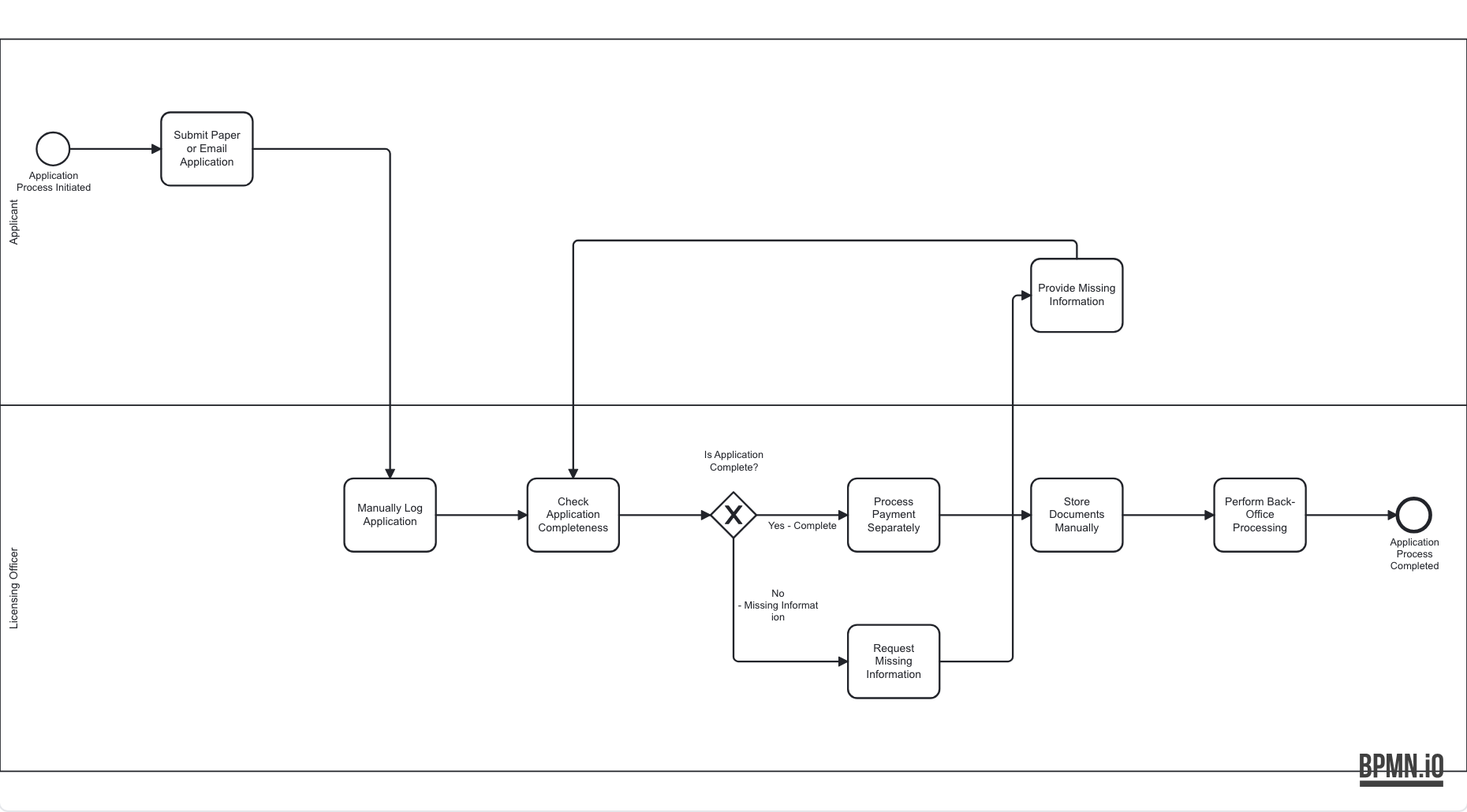
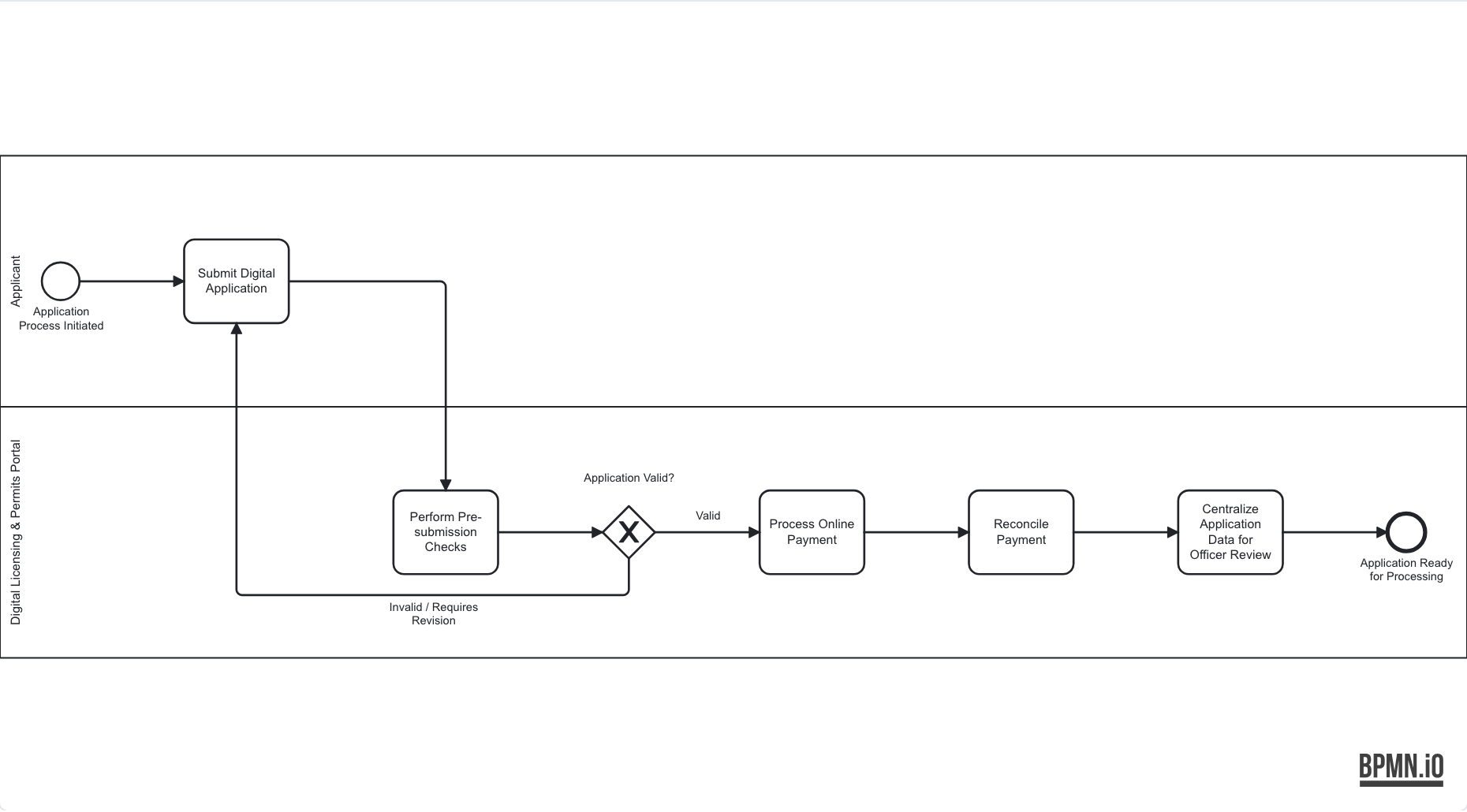
The business process section carries genuine BPMN 2.0 diagrams for both states, generated from the pack’s own process narrative — the current journey through the shared mailbox, the Access database, the separate cashier reconciliation and the posted licence, and the target where the validity check happens before submission rather than days afterwards.
The outcome
The pack reached version 7, each version carrying the reason it was issued and each reason describing a change that was really made — the public register problem raised after sub-committee feedback, the accessibility audit strengthened to meet grant condition B5, the assisted-digital route clarified after research with people who do not use digital services.
Every requirement traces to the objective it serves, a user story and a test case, with no gaps left to assume. For a grant-funded service answerable to a scrutiny committee and a funder who can ask for the money back, being able to show that is not presentation. It is the condition of being allowed to carry on.
Build your own Digital Requirements Pack
Start free, no commitment, and see what Requio drafts for your project.
Get Started